


Introduction
Design, as a discipline, has always been at the forefront of innovation and adaptation. In recent years, the rapid advancement of artificial intelligence (AI) has begun to reshape the very foundations of design, offering new possibilities and challenges for designers and technologists alike. As we navigate this transformation, the principles of simplicity become increasingly important in managing the growing complexity of our technological landscape.
Technology has made our lives more full, yet at the same time we’ve become uncomfortably “full.” This paradox sits at the heart of design’s evolving relationship with AI — we’re creating more powerful tools that simultaneously promise to simplify and complicate our world.
Rapid Experimentation
AI has significantly reduced the cost and time required for design experimentation. Where designers once had to laboriously create multiple iterations, AI can now generate dozens or hundreds of variations in seconds. This democratizes aspects of design while placing greater emphasis on curation and creative direction.
The economics of experimentation have fundamentally changed — AI experimentation is becoming significantly cheaper and faster. For example, GPT-4o now costs just $2.50 per million input tokens, down from $30 for GPT-4 a year earlier. This shift has made sophisticated AI capabilities accessible to a much broader range of creators.
The Emergence of the “Agent Era”
We are witnessing a shift from AI models to task-completing agents. As Lilian Weng defined in her influential tweet, an “agent = LLM + memory + planning skills + tool use.”
These AI agents are capable of executing complex design tasks, potentially revolutionizing workflows and creative processes. Rather than just generating options, these agents can understand context, integrate feedback, and refine their outputs accordingly.
This represents a significant evolution from earlier AI tools that required extensive human guidance. Today’s AI design agents can often understand and implement sophisticated design principles without step-by-step human instruction, working in continuous loops that were previously cost-prohibitive.
Evolution of User Experience
Traditional User Experience (UX) design is evolving into what the report terms “AX” or AI Experience. This new paradigm is “reducing UI in favor of direct AI execution,” suggesting a future where interfaces become more intuitive and less visible.
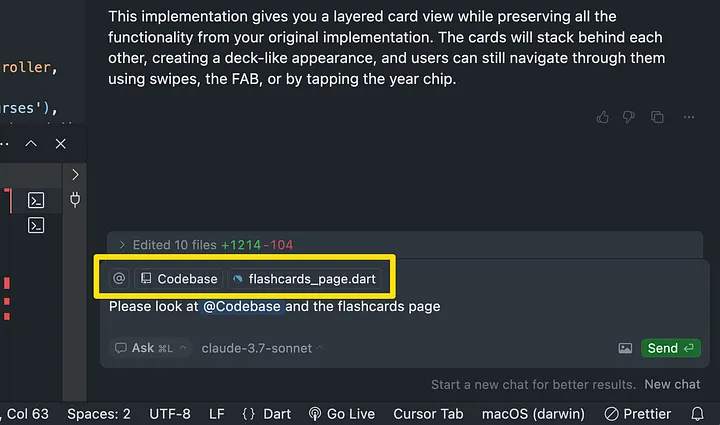
Nick Dobos’s “@context decorators” provide grounding for prompts, enhancing AI accuracy. Meanwhile, Harley Turan’s semantic zoom capabilities allow users to navigate complex information intuitively, and Peter Vidani’s visualization of reasoning traces makes AI thinking transparent.
These innovations appear across different spaces:
- Chat interfaces: Moving beyond simple turn-taking, as seen in Alexander Chen’s elegant three-circle interface that reimagines conversational AI.
- Document spaces: Managing multiple sub-conversations within content, as Tyler Angert demonstrates, or Matthew Siu’s color picker for words that enables semantic exploration.
- Table spaces: Transforming spreadsheet-like interfaces into networks of intelligent cells that collaborate, exemplified by AnswerGrid and Elicit’s Living Documents.
- Canvas spaces: Creating flexible, infinite workspaces like Amelia Wattenberger’s email organizer or tldraw’s collaborative drawing tools.